


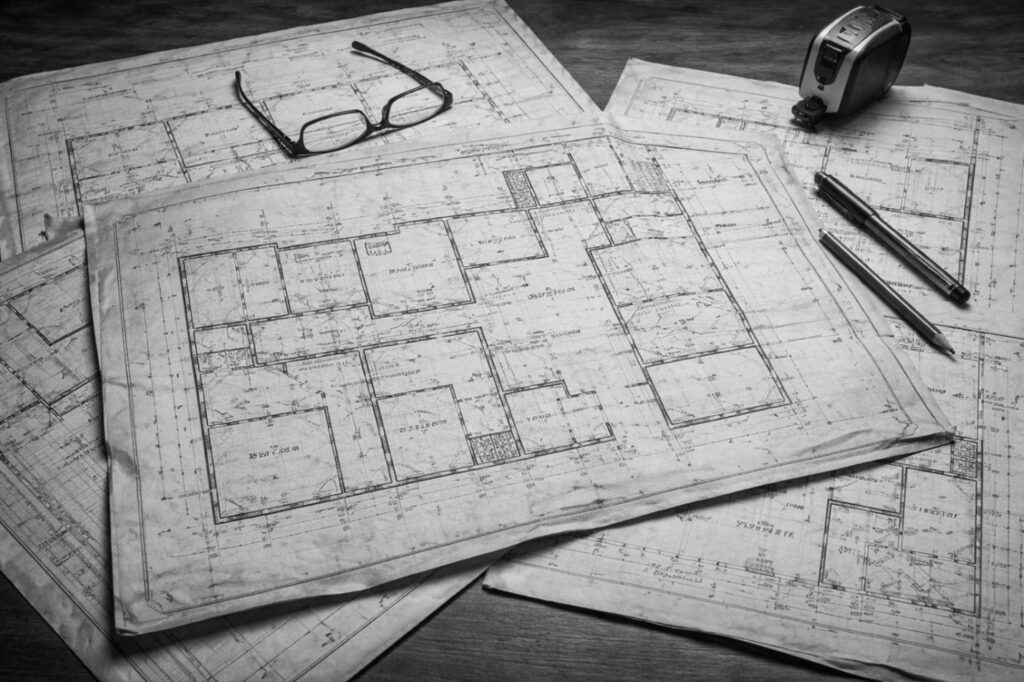
Most buildings have plans. Few have accurate ones.
Almost every commercial building has floorplans on file. They might come from an old leasing package, original architectural drawings, or a set marked up during a renovation. These documents can be useful for reference, but they are rarely an accurate reflection of the building today.
That gap between what is drawn and what actually exists is where as-built floorplans come in.
A clear definition of an as-built
An as-built floorplan is a drawing that shows the building exactly as it exists right now. It is not based on original design intent or past construction. It is created by physically measuring the property and drafting the geometry from real field data.
It becomes a reliable record of the building’s layout. Something you can trust when making decisions.
Why original drawings stop being reliable
If you are using blueprint or plans from when the building was designed, they have never been accurate since construction. Nothing is ever built to plan essentially. Buildings change constantly. Over time, suites are divided, corridors shift, washrooms are renovated, and storage areas are converted into offices. Accessibility updates introduce new walls and doors. Mechanical systems are reworked.
While the building evolves, the drawings often stay frozen in time. In many cases, the only plans available are decades old, even though the space has been modified many times since. Eventually, the difference between the plans and the actual building becomes significant, and even basic information like square footage can no longer be relied on.
How as-built floorplans are created
Creating as-built floorplans starts in the field. A technician measures the building room by room using laser equipment, capturing all accessible areas so the geometry connects across the entire property.
Those measurements are then translated into CAD or Revit to produce a precise digital drawing. Before delivery, the plans are checked carefully to ensure walls align, vertical elements stack properly, and the building closes correctly from a mathematical standpoint.
The result is not a conceptual diagram. It is a working building document grounded in real measurements.
Where they are actually used
As-built floorplans are often associated with architects, but in reality, they are used across the full lifecycle of a property.
They support leasing by providing accurate suite sizes and layouts that match the space being marketed. They form the basis for BOMA lease area calculations, where precision matters. They give architects and contractors a reliable starting point for renovations, reducing the risk of surprises during construction.
They are also used in day-to-day operations, from space planning to maintenance coordination. Increasingly, they are requested during financing, sales, and insurance reviews as part of due diligence.
The risk of operating without them
The issue is not just inconvenience. It is uncertainty.
When drawings no longer match the building, leasing areas become questionable and renovation costs become harder to predict. Contractors build in contingency, and tenant disputes become more difficult to resolve. Decisions are still being made, but they are based on assumptions instead of verified information.
Why they become a long-term asset
Most clients request as-built floorplans for a specific reason, often a renovation or a BOMA analysis. What tends to happen is they quickly become a long-term reference for the building.
They are reused for future tenants, capital projects, leasing materials, and space planning. Once accurate documentation exists, many of the small inefficiencies that slow down projects begin to disappear.
A more accurate way to understand your building
Every building has systems that support how it operates. There are mechanical systems, life safety systems, and financial systems. There is also a spatial system, the physical layout that shapes how the building functions every day.
As-built floorplans are simply the verified record of that layout. Without them, decisions are based on outdated information. With them, decisions are based on the building as it truly exists today.
If you are unsure whether your current plans still reflect your property, it is worth taking a closer look before a project forces the question.